Objectives
- Developed deep learning (DL) models for automated coronary artery disease (CAD) diagnosis using single-photon emission computed tomography myocardial perfusion imaging (SPECT-MPI) polar maps.
- Compared various training strategies, including supervised, semi-supervised, and transfer learning, with different input types (rest, stress, early fusion, and late fusion).
- Evaluated models' performance in two tasks: (1) automating expert reader (ER) diagnosis and (2) predicting invasive coronary angiography (ICA)-based diagnosis.
- Demonstrated that combining data with and without ICA, along with semi-supervised learning, can improve DL model performance.
Methodology
- Implemented 13 different convolutional neural network (CNN) models, including CNN1, CNN2, DenseNet (121, 169, 201), EfficientNet (B0, B3), InceptionResNetV2, InceptionV3, ResNet (101V2, 152V2, 50V2), and VGG19.
- Used quantitative perfusion SPECT (QPS) to extract polar maps of rest and stress states.
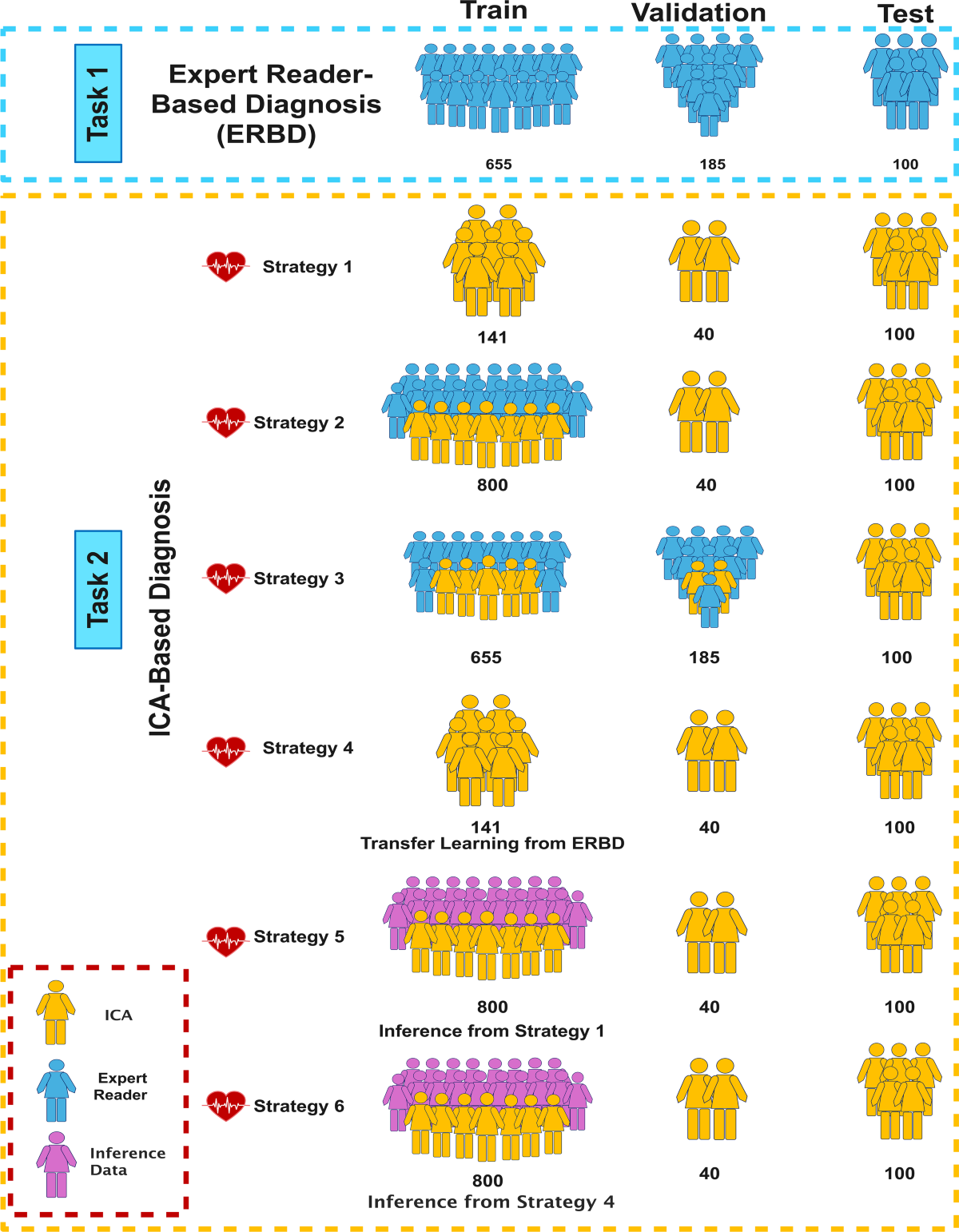
- Defined two tasks: (1) automated CAD diagnosis with ER assessment of SPECT-MPI as reference, and (2) CAD diagnosis from SPECT-MPI based on reference ICA reports.
- In Task 2, used six strategies for training DL models, including combinations of ER- and ICA-based diagnoses, and semi-supervised learning.
- Utilized four input types: rest polar maps, stress polar maps, early fusion (two-channel images of stress and rest), and late fusion (separate stress and rest inputs with 2D spatial pyramid pooling (SPP)).
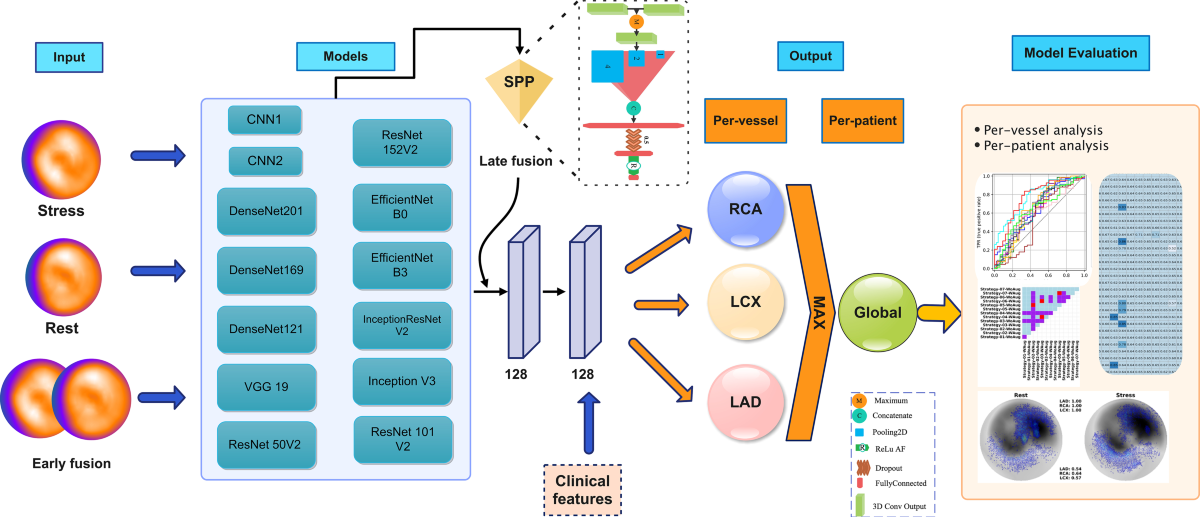
- Incorporated data augmentation (±10° rotations) and clinical features (age, gender, weight, height).
Results
- In Task 1 (ER-based diagnosis), the best models achieved AUCs of 0.89 (DenseNet201 Late Fusion) in per-vessel analysis and 0.83 (ResNet152V2 Late Fusion) in per-patient analysis.
- In Task 2 (ICA-based diagnosis), the best models achieved AUCs of 0.71 (Strategy 3, WoAug InceptionResNetV2 EarlyFusion) in per-vessel analysis and 0.77 (Strategy 5, WoAug ResNet152V2 EarlyFusion) in per-patient analysis.
- Statistical tests (DeLong and Wilcoxon rank sum) showed significant differences between models and strategies.
- The best DL model in per-patient analysis (Strategy 5 WoAug ResNet152V2 EarlyFusion) outperformed the expert reader's SS-based diagnosis in LAD (AUC: 0.80 vs. 0.58) and improved the new ER's performance with DL assistance (AUC: 0.68).
Discussions
- The study is comprehensive, exploring numerous DL models and training strategies. However, the sample size with ICA as the gold standard is relatively small (n=281). While the authors address this by incorporating ER-based diagnoses, the inherent subjectivity of ER assessments introduces a potential bias.
- The rationale for choosing specific DL architectures (CNN1, CNN2) is not clearly explained. Providing more details on the design choices would strengthen the methodology.
- The study uses a ±6-month window between SPECT and ICA. This could be a limitation, as disease progression might occur within this timeframe. A shorter interval would be preferable.
- While saliency maps are presented, their interpretation and clinical utility are not thoroughly discussed.
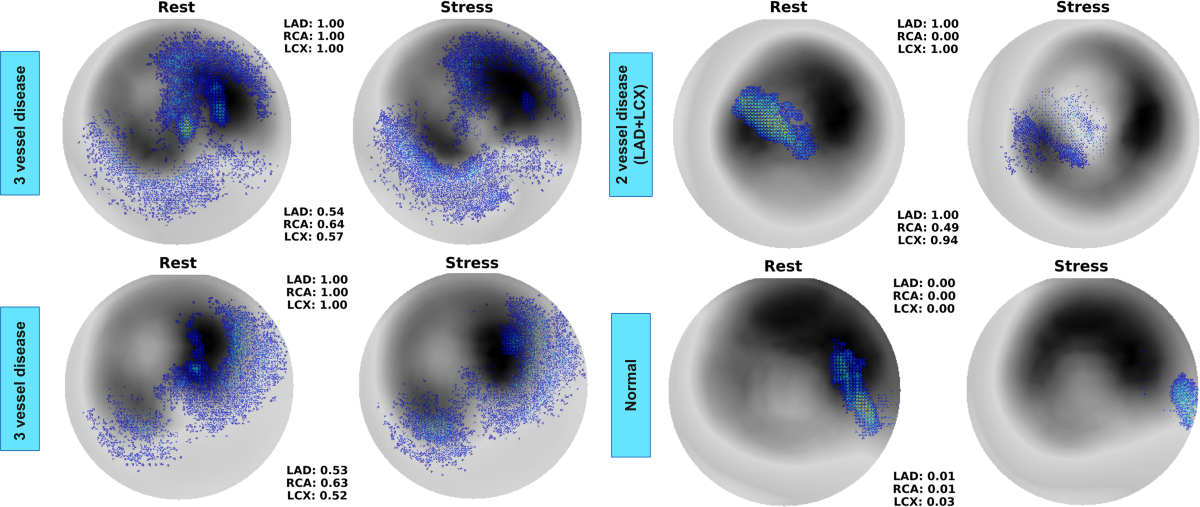 A more detailed analysis of how these maps correlate with specific angiographic findings would be valuable.
- The study lacks external validation. Testing the models on an independent dataset would significantly enhance the generalizability of the findings.
Comments
Join the discussionNo comments yet. Be the first to comment.