Objectives
This article reports findings from the 1st survey on nuclear brain imaging in Germany (Oct 2023 - Jan 2024) regarding the current status and potential capacity for amyloid Positron Emission Tomography (PET) scans. Key findings include:
- Amyloid PET is relatively widespread, especially in university hospitals (UH), but overall scan numbers are currently low (~800/year among respondents).
- There is significant potential capacity for an increase (estimated ~5,000 additional scans/year among respondents), suggesting an approximate sevenfold increase is possible with existing infrastructure.
- Germany appears generally prepared regarding PET/CT scanner access, trained staff (≥400 physicians trained in reading amyloid PET), and tracer availability to meet an initial surge in demand following the approval of anti-amyloid Alzheimer's Disease (AD) therapies, assuming adequate reimbursement.
Methodology
The study employed a survey methodology targeting nuclear medicine physicians in Germany via email lists from the German Society of Nuclear Medicine and the Professional Association of German Nuclear Medicine Physicians.
- Data Collection: A questionnaire (Microsoft Excel) with 33 predefined multiple-choice questions (covering frequency/indications, expertise/acceptance, DAT SPECT methods) was used. Participants selected predefined ranges for scan frequencies based on recall ('off the top of their head').
- Data Analysis: Total scan numbers and capacity were estimated by representing selected ranges by their mean value (e.g., 26-50 scans represented as 38). The highest range (>100) was estimated as 125.
- Representativeness Assessment: The survey's coverage was estimated by comparing the total reported Dopamine Transporter (DAT) SPECT scans (~7,800/year) to national data (~14,890/year), indicating ~52% coverage.
Results
The conclusions are based on data from 82 responding institutions (33 practices (PR), 15 non-university community hospitals (CH), 34 university hospitals (UH)).
- Current Amyloid PET Usage: 76% of UH perform amyloid PET regularly, compared to only 18% of PR and 40% of CH. Most institutions perform few scans; only 12% reported >50 scans/year. The total estimated annual clinical scans across respondents is ~800.
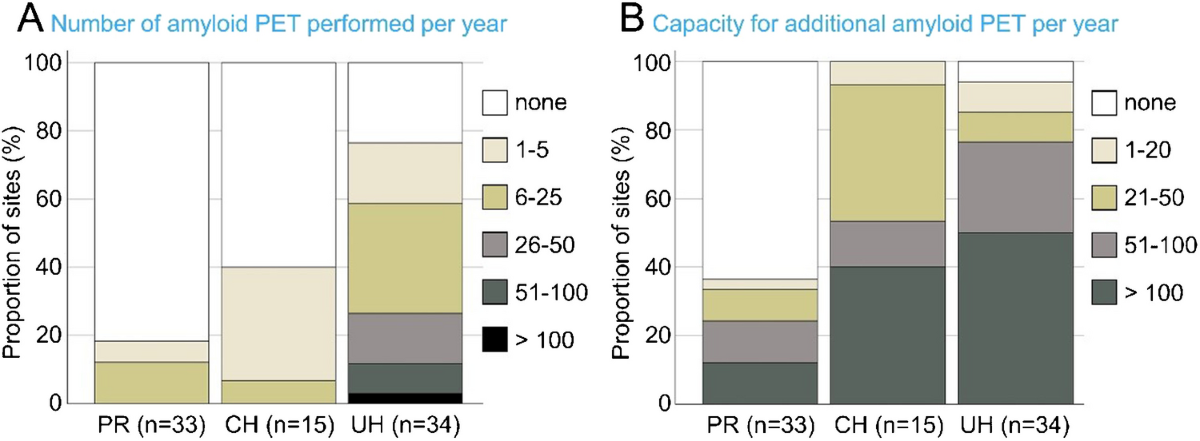 A
A - Additional Capacity: Capacity for >50 additional scans/year was reported by 24% of PR, 53% of CH, and 76% of UH. The total estimated additional capacity is nearly 5,000 scans/year across respondents, suggesting a potential ~7-fold increase ((5000+800)/800). B
- Staffing & Infrastructure: Data indicates ≥400 physicians are trained to read amyloid PET scans. Access to PET/CT scanners and commercial tracers is considered ubiquitous, though supply flexibility could be improved.
- Representativeness: The survey covered institutions performing ~52% of all DAT SPECT scans in Germany, suggesting reasonable representativeness.
Discussions
The study provides a valuable snapshot of amyloid PET readiness in Germany, but several limitations should be considered:
- Data Granularity: Using broad, self-reported ranges for scan frequency ('off the top of their head') introduces potential inaccuracy in the estimations of current volume and capacity. Actual logged data would provide a more precise baseline.
- Capacity Definition: The reported 'additional capacity' assumes adequate reimbursement but doesn't detail other potential constraints like specific slot availability (competing with other PET scans like oncology or FDG-PET brain), technologist staffing, or guaranteed daily/flexible tracer delivery schedules, especially for non-UH sites.
- Representativeness Nuance: While the 52% coverage based on DAT SPECT is a good indicator, the representativeness specifically for amyloid PET might differ, as institutions performing DAT SPECT may not necessarily offer or plan to offer amyloid PET. The response rate from PR and CH is relatively low compared to UH.
- Reader Availability vs. Access: Knowing ≥400 readers are trained is positive, but the survey doesn't assess their distribution relative to the institutions with PET scanners or their actual availability/commitment to read scans promptly within the clinical workflow.
Comments
Join the discussionNo comments yet. Be the first to comment.