Objectives
- This study investigates the prognostic impact of lymph node metastases (LNM) detected on post-therapy 131I single photon emission computed tomography/computed tomography (SPECT/CT) in patients with differentiated thyroid cancer (DTC).
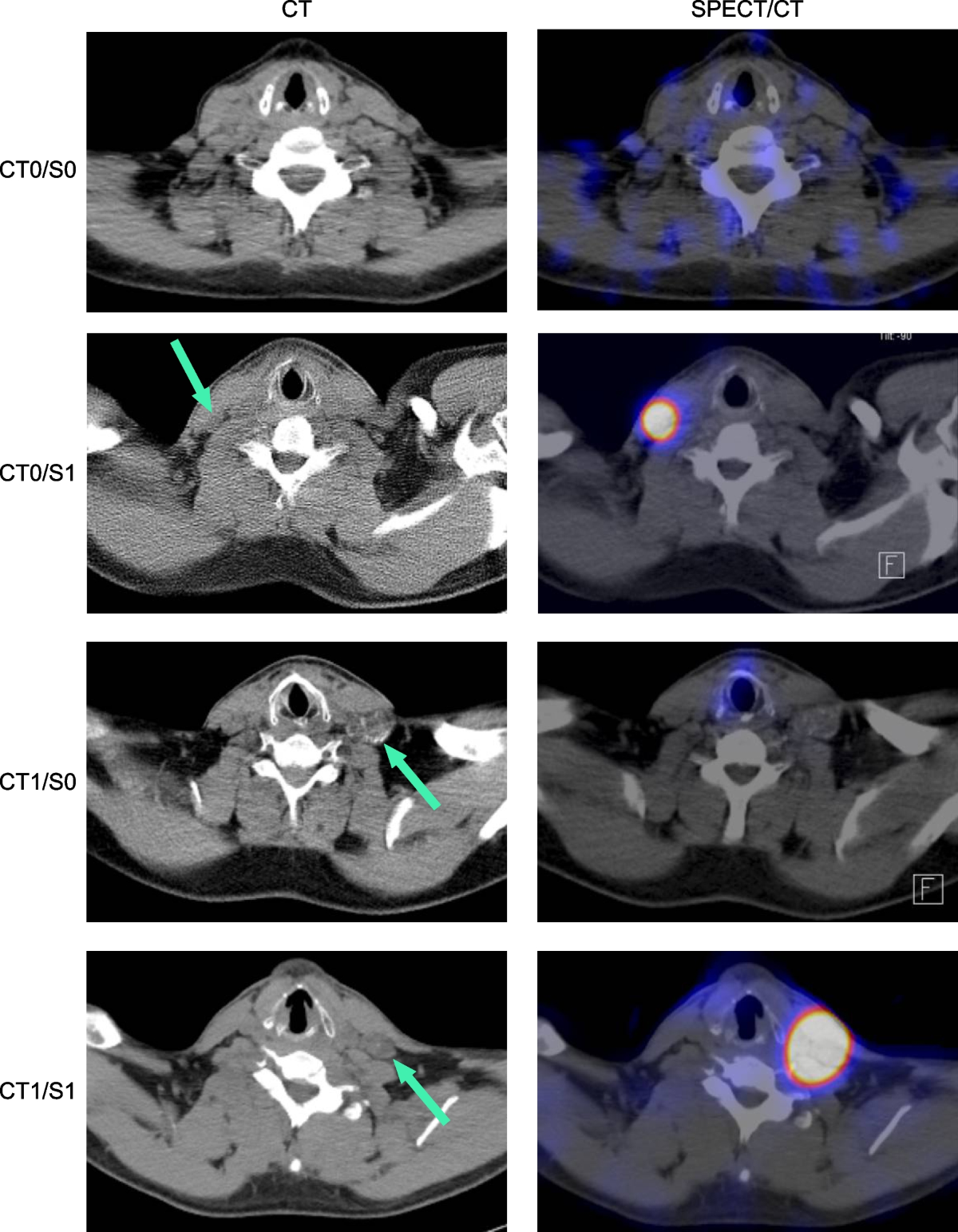
- It categorizes LNM based on size (<1 cm, ≥1 cm) and 131I uptake.
- It analyzes the effect of LNM characteristics and subsequent treatment (reoperation vs. radioiodine therapy (RAI)) on complete response (CR) and progression-free survival (PFS).
Methodology
- Retrospective analysis of 942 DTC patients who underwent cervical 131I SPECT/CT after their first RAI.
- LNM were categorized based on CT (enlarged ≥1 cm, small <1 cm) and 131I uptake (positive or negative).
- Kaplan-Meier curves and Cox regression were used to analyze CR and PFS.
Results
- Patients with no LNM had a shorter median time to CR (9.4 months) than those with LNM (44 months, HR 2.2; p<0.01) and a lower risk of progression (median PFS not reached, HR 0.46; p<0.01).
- Among patients with LNM, those with enlarged 131I negative LNM had the longest time to CR (24 months, HR 0.36; p<0.01).
- Patients with small LNM had a PFS similar to patients without LNM (median PFS not reached, HR 1.22; p=0.54).
- Reoperation after first RAI (13.5 months) led to earlier CR than second RAI (median not reached) in patients with enlarged LNM.
- For small LNM, second RAI was associated with longer PFS than reoperation (38.4 months vs. not reached, HR 4.0; p=0.02).
Discussions
- The study is limited by its retrospective design, although the large cohort size is a strength. The single-reader image analysis introduces potential bias, and an interobserver comparison would strengthen the findings.
- The definition of pathological 131I uptake, while using a reference organ (salivary glands), is novel and its validity in DTC requires further investigation.
- The lack of contrast-enhanced CT limits the diagnostic power of the CT component.
- The study did not incorporate biochemical markers like Thyroglobulin (Tg), which are important prognostic indicators in clinical practice. Future studies should integrate both imaging and biochemical data.
- The small number of patients in the enlarged 131I-negative LNM subgroup (n=22) limits the conclusions that can be drawn regarding treatment decisions for this group.
Reference: 131I SPECT CT provides prognostic information in patients with differentiated thyroid cancer
Comments
Join the discussionNo comments yet. Be the first to comment.