Objectives
- Evaluated the cost-effectiveness and quality of life impact of incorporating Prostate-Specific Membrane Antigen (PSMA) Positron Emission Tomography/Computed Tomography (PET/CT) into the current diagnostic algorithm for prostate cancer, which includes Prostate-Specific Antigen (PSA) testing and multiparametric Magnetic Resonance Imaging (mpMRI).
- Compared a standard of care MRI-driven diagnostic pathway to a strategy incorporating PSMA-PET/CT to potentially avoid unnecessary biopsies.
- Found that adding PSMA-PET/CT to MRI in patients with equivocal MRI findings (PI-RADS 3) is borderline cost-effective, while in men with negative MRI (PI-RADS 1-2) it is not.
Methodology
- A life-time decision model was used to compare the two diagnostic strategies.
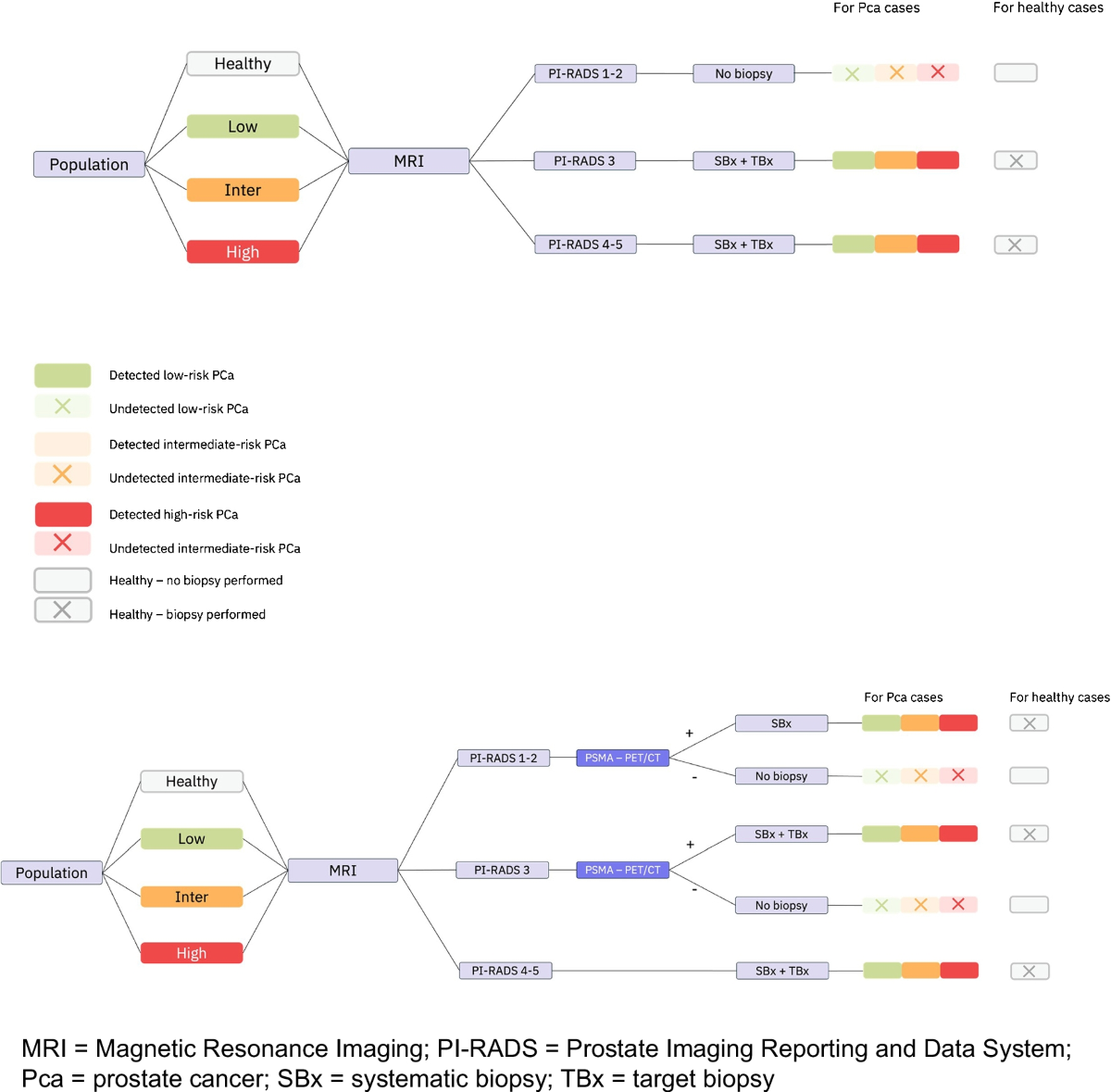
- The model combined a decision tree and a state transition model.
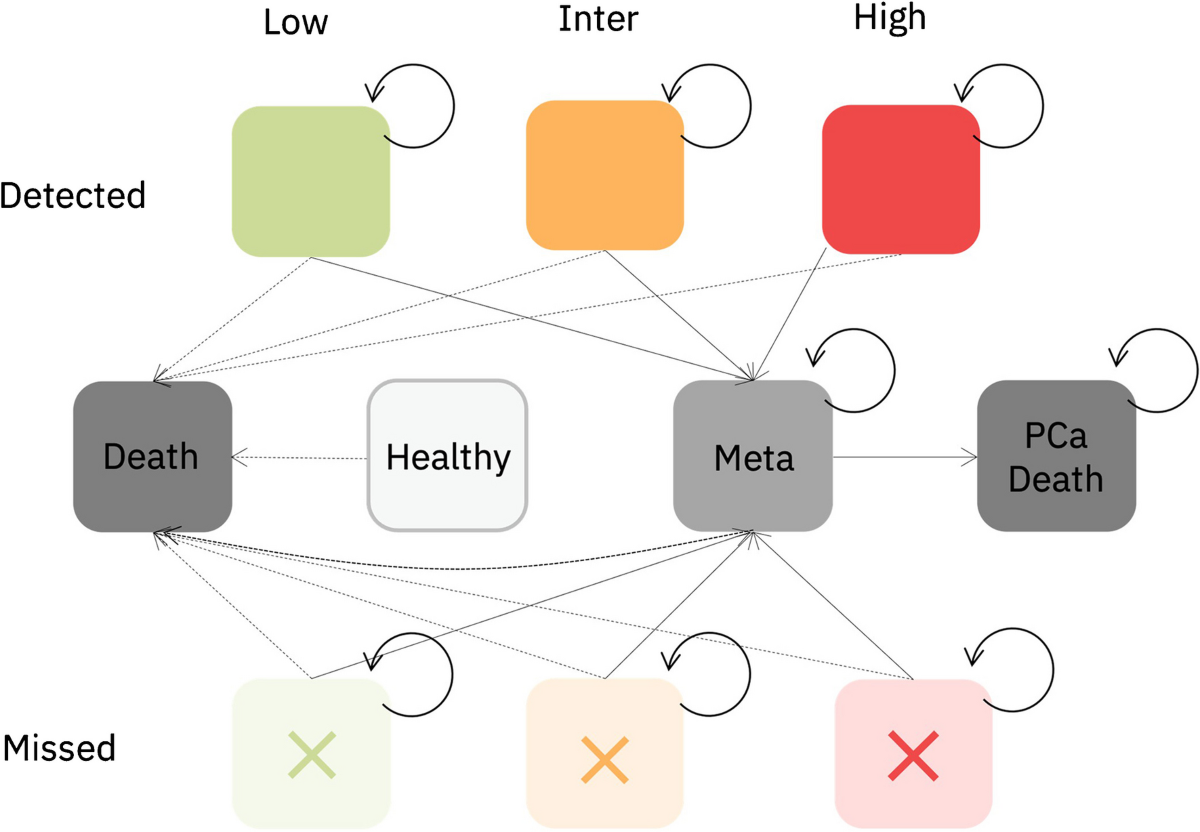
- Individual patients were simulated with a disease status and age.
- The decision tree represented the diagnostic and initial treatment pathway.
- The health state transition model represented patient follow-up and assessed the consequences of the diagnostic and treatment pathway outcomes.
- Long-term quality-adjusted life years (QALY) and healthcare costs were calculated for each approach.
- Model inputs included disease prevalence, treatment distributions, side effects, costs, quality of life values, progression rates, and mortality.
Results
- In PI-RADS 3 lesions, PSMA-PET/CT improved per-patient QALY by 0.002 and was borderline cost-effective, with an increased cost of €170-€186 per patient and an incremental cost-effectiveness ratio (ICER) of €56,700-€93,212 per QALY.
- In PI-RADS 1-2, PSMA-PET/CT led to a per-patient QALY decrease of 0.001 points, a cost increase of €416-€429 per patient, and was thus not cost-effective.
- In PI-RADS 3, PSMA-PET/CT could have prevented biopsies in 107 or 121 patients (out of 1000), but 10 or 14 low-risk prostate cancers would have remained undetected.
- In PI-RADS 1-2, 58 or 78 additional biopsies would have been performed, resulting in the diagnosis of 13 or 44 additional low-risk prostate cancers, 14 or 19 intermediate-risk, and 0 or 6 high-risk prostate cancers.
Discussions
- The study is limited by the relatively small sample sizes used for the PSMA-PET/CT outcomes, although different input models were utilized. Larger, phase 3 data is needed to confirm these findings.
- The study used Dutch healthcare costs, which may not be generalizable to other countries. Cost-effectiveness outcomes may vary depending on local intervention costs.
- The model assumes a PSMA-PET/CT cost of €1129, which is at the lower end of the price range. Strategies to further reduce costs are needed to expand PSMA-PET/CT use in earlier settings.
- The study used different tracers ([18F]PSMA-1007 vs. [68Ga]Ga-PSMA-11) in the initial study and the external PRIMARY1 trial, which could lead to different scan results and affect the generalizability of the findings.
Comments
Join the discussionNo comments yet. Be the first to comment.